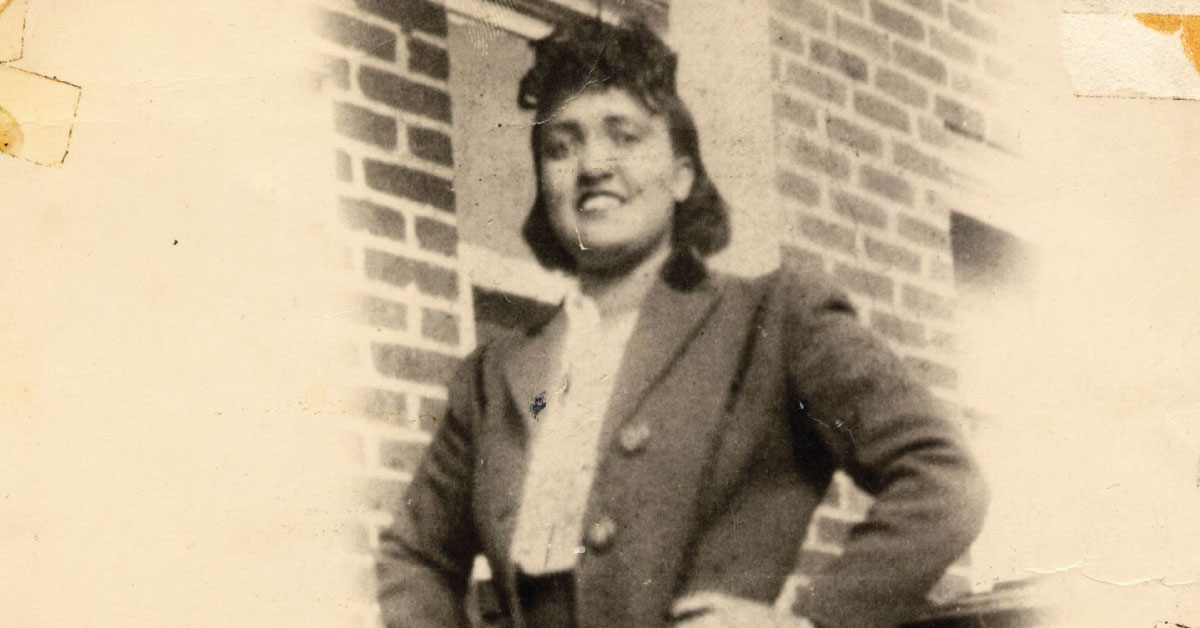
Willard Library will host a traveling exhibit honoring Henrietta Lacks, the “Mother of Modern Medicine” on Wednesday, Nov. 12 from 11 a.m. to 7 p.m. in the downtown location programming room, 7 W. Van Buren St.
Lacks’ great nephew (and Kalamazoo native) Jermaine Jackson will give a lecture followed by a question and answer session at 6 p.m.
Henrietta Lacks was a Black woman whose cancer cells, taken without her consent, became the first immortal human cell line, contributing to numerous important medical breakthroughs.
Local history librarian and archivist Michael McCullough described Lacks’ legacy. “It’s virtually impossible to overstate the significance of Lacks’ contributions to medicine. When Lacks sought treatment for cervical cancer at John Hopkins Hospital – one of the few that treated Black people – researchers discovered that her cancer cells had a unique property: unlike most cells, which die quickly outside the body, hers continued to divide indefinitely,” he said. McCullough continued, “These ‘immortal’ cells became the first immortalized human cell line. Scientists and medical researchers credit the cell line for the development of the polio vaccine and other cancer therapies.”
Until recent history, Lacks contribution to modern medicine went largely unnoticed. McCullough explained, “Lacks has been called ‘invisible but foundational’ to many medical breakthroughs. Invisible because neither Lacks nor her family knew that her cells had been taken or used for research. For decades, her contributions went unacknowledged, while pharmaceutical and research industries benefited from discoveries made using the so-called HeLa cells.”
It wasn’t until the publication of the book “The Immortal Life of Henrietta Lacks” by Rebecca Skloot in 2010 that the story really gained national and international attention. “Historians and ethicists call that recognition a turning point in conversations about consent and racial justice in medicine. Lacks’ cells were taken without her permission, and they became a tool for saving millions of lives,” said McCullough. “She’s finally getting her due. In 2021, the World Health Organization honored her with a posthumous award, calling her ‘a woman who gave the world more that it ever gave her.’”
The traveling exhibit showcases artwork created by artists in tribute to Lacks, as well as family photos, memorabilia, articles, and video interviews, all on loan from Lacks’ grand-nephew Jermaine Jackson, who will be on hand throughout the day to answer questions.
McCullough reflected on Lacks legacy, “The restoration of Lacks’ humanity and dignity changed the conversation about medical research, and that may be her greatest legacy. It’s a reminder that behind every lab result or discovery is a human being with a story.”